The transit and review layer for biomedical R&D data
Myelin brings your partners’ data in, and holds it to your standards on the way.
Problems surface while your partner can still fix them, not a month later when your bioinformatician opens the files.
Why it exists
Someone on your team is already doing this full-time — chasing files, not doing science.
Every partner, a new pipeline
Email, ad-hoc SFTP, a SharePoint link. The same plumbing rebuilt for each collaboration, then maintained forever.
Every exchange, another email thread
Forty people in copy, and a coordinator whose only job is asking “can you answer this?” The answer takes days, because it belongs to no one.
Ingestion eats expert time
Scientists spend their hours on checksums and folder conventions — not on the data itself.
Responsibility blurs
When bad data lands, is it the partner, IT, or the study team? Nobody owns quality, so everybody re-checks everything.
Meanwhile the interim analysis date is set by a committee and it does not move, so the meeting happens with whatever data made it in.
What Myelin is
Myelin keeps partner collaboration moving without the friction.
You set up a Bridge: a private, permanent connection between your organisation and one partner. You configure your side once. The partner configures theirs, the same way — no negotiation between IT teams.
From there, the signal moves on its own: the same fast, validated path, batch after batch. Nothing to rebuild.
A new partner becomes an invitation, not an infrastructure project. No ticket, no queue — just the people who know the science, back in control.
own their deliveries
Each submits through its own Bridge, and fixes its own data at the source.
own their studies
Each runs its own projects and review decisions, without waiting on a central queue.
owns the coherence
One structure, versioned rules, one record, so autonomy never turns into chaos.
Who does what
Myelin gives every role its own view of the project — nobody chases anyone by email.
Project Owner
Opens the project, invites the team and the partner. Sees the whole picture.
Partner
Submits, sees the verdict, resubmits if needed. Never opens an inbox to ask “did you get it?”
Reviewer
Sees exactly which batches are waiting, and nothing else. Reviews, comments, decides.
Analyst
Only sees data once it’s validated. Nothing lands on their desk before it’s ready.
One dashboard, every pending action, every role. Nobody has to ask.
How it works
You set the standards once. Myelin applies them to every delivery after that.
01
Set your standards
Your quality team picks the checks a delivery has to pass, per data type. A study can add to that set — but never remove from it.
02
Open a Bridge
Invite the partner. Everything they need is behind the link.
03
Review what arrives
The checks have already run. Your reviewer sees the verdict on every file, then accepts or sends it back with the reason.
04
It lands in your cloud
Validated data goes to the bucket you own, with a record of exactly what it passed.
Samplesheet lists
Delivered
Every delivery answers three questions
Is everything here?
Automated, before a byte is uploaded
Is it the right data?
Your reviewer, against the analysis plan
Is it good enough?
Your expert, against the assay’s acceptance criteria
Myelin answers one. Your people answer the other two.
What Myelin checks
Myelin runs a different set of rules for genomics than for imaging.
Genomics
Sample folders of FASTQ or BAM, with a samplesheet.
Every read file must have its mate, and every alignment its index.
✗ catches a sample delivered half-paired
Imaging
Study and series folder trees.
Only the agreed formats belong inside a series.
✗ catches JPEG previews mixed into a DICOM series
CRO study deliveries
Reports, QC documents and structured outputs.
No file may be empty or truncated.
✗ catches the interrupted upload that leaves a stub, which looks normal in a listing
Your quality team chooses from the catalogue and writes its own where the catalogue stops.
Where it is used
Same platform. What it solves for you depends on where you sit.
Universal
Data reaches researchers faster
It existed for weeks before anyone could touch it. Myelin closes that gap.
The process outlives the person
What used to live in one inbox now lives in the platform. A new hire, a new partner — nothing to rebuild.
For big teams
IT and R&D stop negotiating every connection
Security keeps its standards. R&D keeps its speed. Neither side has to give in to the other.
One vetted entry point, not a dozen ad hoc ones
Fewer connections touch your boundary. Smaller attack surface, simpler governance.
For small teams
Fewer Data Management resources needed
The checks for genomics, imaging, or a CRO delivery are already built — nobody on your team has to write or maintain them.
Infrastructure that scales as fast as you do
Partner ten is as easy as partner two — even if you didn’t have a data-ops function eighteen months ago.
More scenarios, worked through in full: the use cases page.
Security and boundaries
Myelin holds your data only while it is being decided.
EU infrastructure
Holding, review and the record run in the EU. Your destination bucket is wherever you already keep your data.
One partner never sees another
No shared credentials to leak, and no folder two partners both reach.
Every step is recorded
Each state change is written to a tamper-evident trail. You can export it and verify it has not been altered.
Running a third-party risk review? The security overview is the five-minute version.
Where we are
Myelin is built and running. What it does not have yet is your delivery.
We are before our first customer and looking for a few founding partners. There is no case study to show you, so here is the product, built for terabyte-scale deliveries made of many files, each up to 20 GiB.
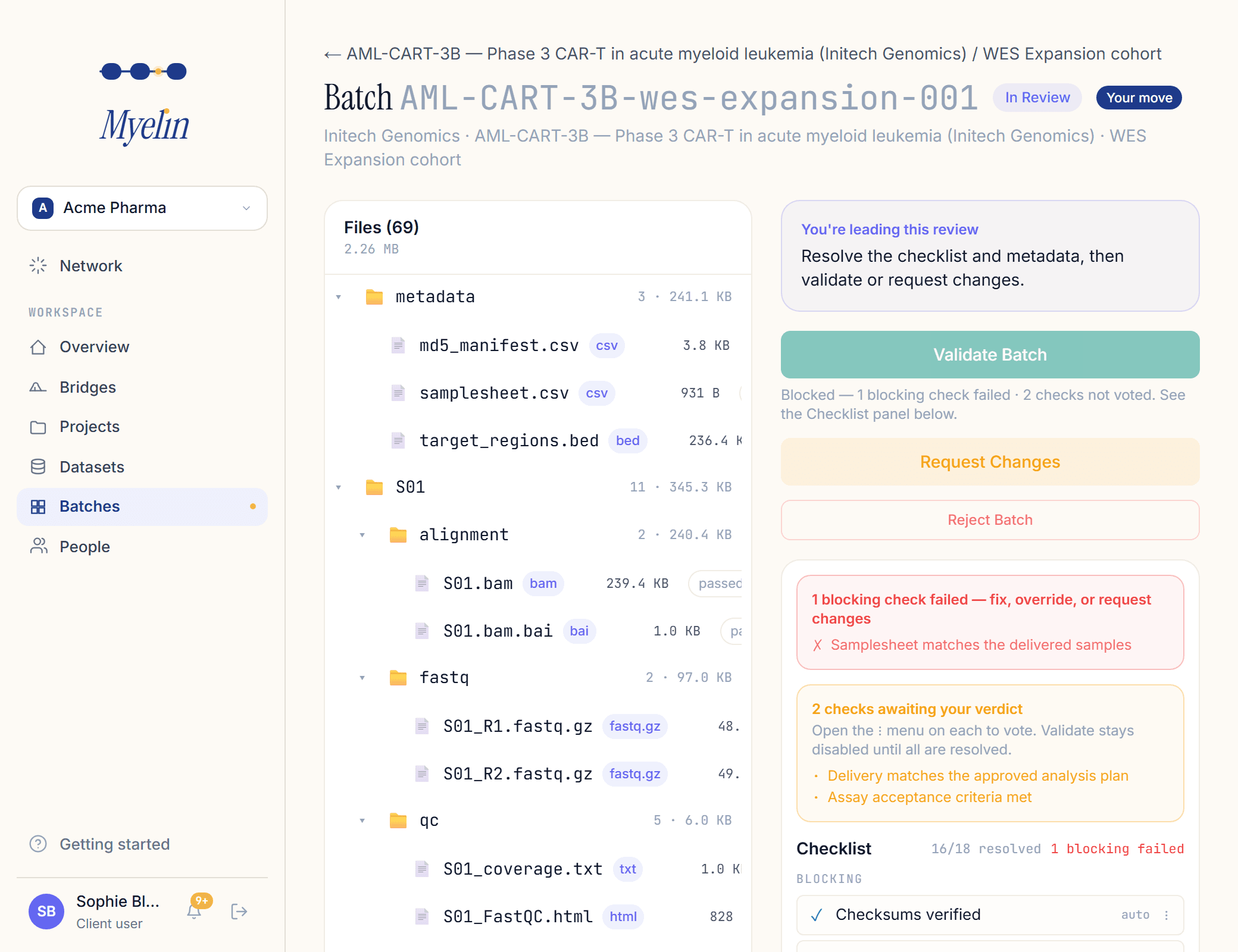
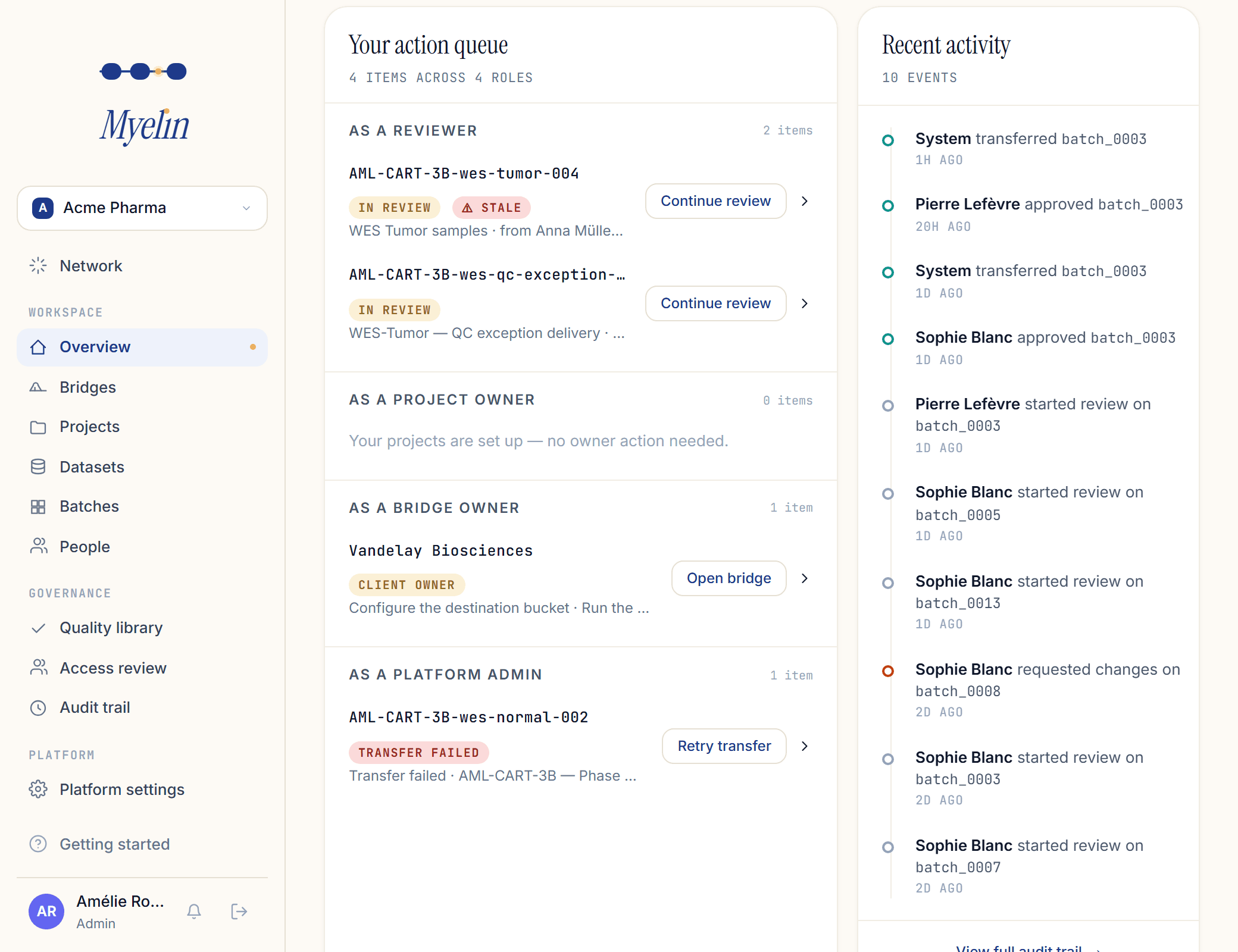
Built by someone who ran this problem from the inside. Meet the founder.
The direction
RoadmapNext, Myelin will make five partners read as one.
Today each delivery is checked against what its own partner promised. The next step is harmonisation across partners and studies: one vocabulary, so a field three CROs send three ways will arrive as one column. It is on the roadmap, not in the product. Founding partners will define that vocabulary rather than inherit one.
Start with one delivery.
A pilot can start with one partner, one project, one dataset. It ends with your first validated delivery landing in your own bucket, fully traced. Your teams never build another pipeline.
Request a pilotForward the security overview to your risk review. EU infrastructure · transit, not storage · tamper-evident audit trail.